For this edition of our Women in Quantum series, we spoke with Juhi Singh, Quantum Algorithms Engineer at planqc. She works at the interface of theory and experiment, contributing to both hardware optimization and quantum algorithms. Juhi shares her journey from India to Germany and reflects on how curiosity and persistence have shaped her path in science.
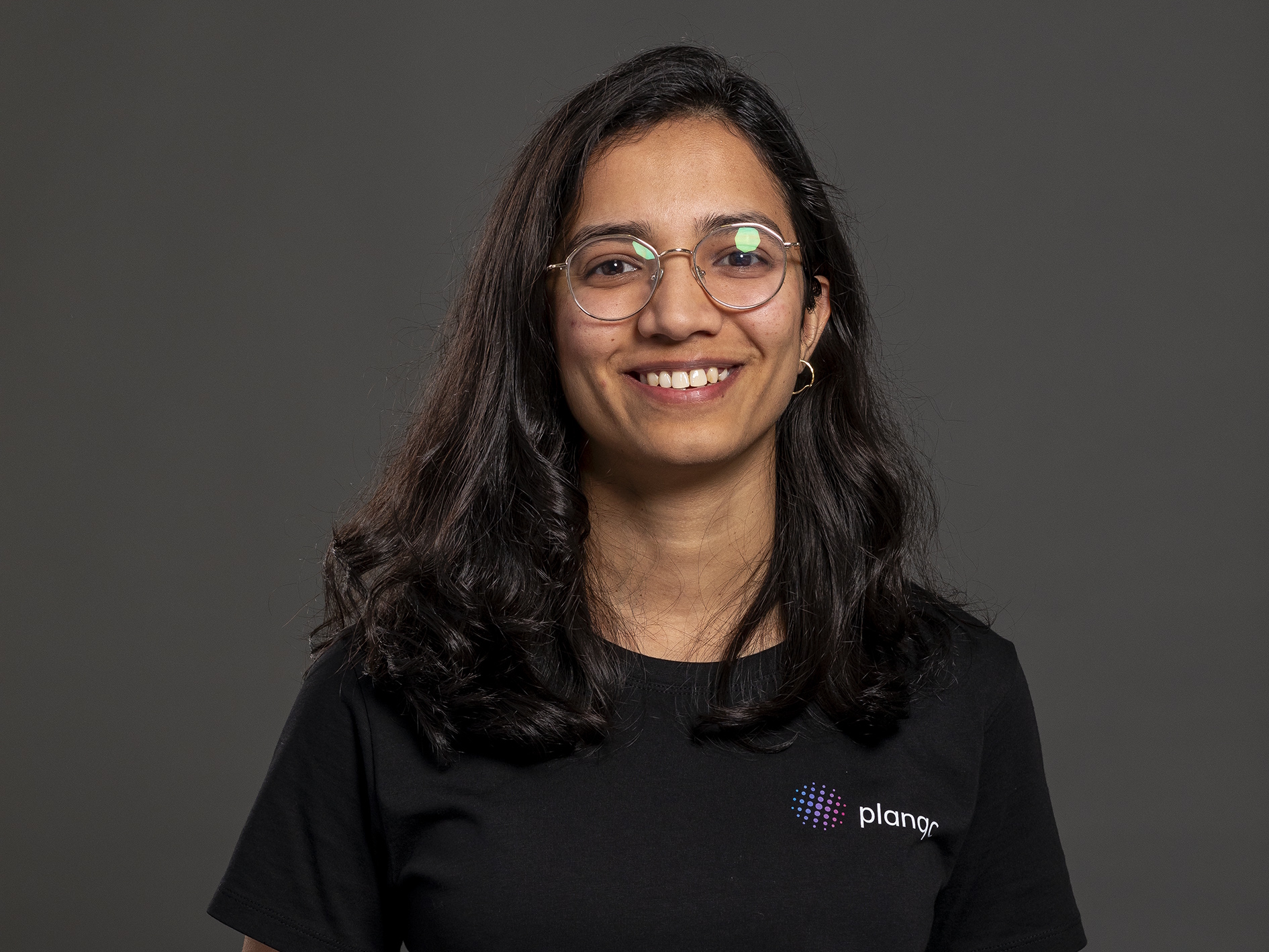
Juhi, what is your name, current role, and your connection to planqc?
I am Juhi Singh, currently working as Quantum Algorithms Engineer at planqc. I work on a variety of topics ranging from the very low level modeling of hardware components to developing quantum algorithms suitable for the hardware.
Can you tell us briefly about your professional background and how you joined the company?
I did my bachelor’s and master’s in India and moved to Germany for my Ph.D. in theoretical physics. In my Ph.D. I worked very closely with neutral atom devices which brought my attention to different research groups and companies working in this area. Since I was a theory person working very closely with experimentalists during my Ph.D., planqc was a very ideal place for me. Working in a company like planqc could allow me to engage with the experimentalists on a day-to-day basis and give a real time experience of building the quantum machine. With all these motivations, I applied and joined planqc.
“I constantly had some very close friends, men and women, and some professors who constantly believed in me and boosted my confidence.”
What inspired you to pursue a career in science, technology, or innovation?
My initial interest in science grew during school when my elder siblings were already studying science on different levels and I could see their books, the small home science projects and so on. This grew increasingly stronger, and I did start taking physics and math very seriously with the ambition of applying to some good engineering programs in India (P.S. they are super competitive :-)).
But as I moved forward in my studies, I started enjoying physics more and moved towards a proper physics bachelor’s and master’s degree. During my master’s I started to understand physics and had a few professors who played the role of great mentors, especially a female professor who indirectly gave me a lot of confidence and inspiration. This finally gave me enough confidence to do a Ph.D. in Germany and move forward in this field.
Being in a field that is still predominantly male, did you experience feeling like a minority during your studies or early career? If so, were there any particular moments, feelings, or challenges, and how did you deal with them?
It was not obvious and strong but there were some times when I had imposter syndrome when looking at a group of men discussing science and/or doing social things together. For instance, once, I decided to drop a course along with my other male classmate, and the next time I met the professor, he asked me why my classmate decided to drop it and nothing about me. It felt a bit weird, especially when I had constantly scored high marks in that prof’s courses. There were very few incidents like this, but it left a memory.
However, I constantly had some very close friends, men and women, and some professors who constantly believed in me and boosted my confidence.
What has been a highlight or proudest moment in your career so far?
My proudest moment was getting a Ph.D. position in theoretical physics in one of the renowned institutes in Germany. Especially because I come from low-ranking state universities, where the percentage of people managing to get a good Ph.D. position is very low, and I did not have prior research experience. I later got to know from my Ph.D. supervisor that the reason they offered me the position was a short story I told them during the interview :-).
During my master’s, we did not have any quantum computing course at our university, so four students, including me, decided to find a professor who was already retired and ask him to teach the course to us. Since he was retired, he was not allowed to supervise any master’s students’ theses, but at least we got the knowledge of it. So, in short, my desire to learn was the key to my Ph.D. offer.
What is your role within the company, and how does your work contribute to planqc’s mission?
Currently I work as a quantum algorithms engineer at planqc. I use all my expertise learned in my Ph.D. in two main subdomains of planqc. The first is to improve the hardware by simulating and optimizing its components. The other part is to extend our algorithm package with new NISQ and fault-tolerant quantum algorithms, which will be implemented on the hardware in the future.
Why do you think diversity of roles – from research to administration, business development, HR, and beyond – is important in quantum technology?
Like any complex ecosystem, the field of quantum technology thrives when many different types of expertise and perspectives come together. Especially in a company like planqc, which is building the technology redefining the future of society, we need minds who can think of every possible aspect of it.
“The field of quantum technology thrives when many different types of expertise and perspectives come together.”
I am glad that planqc is doing such a great job in it, by hiring people in different roles across research, administration, business development. Only by collaborating with each other and others outside planqc can we understand the practical use cases, find the challenges and limitations, and provide solutions for this technology.
What do you enjoy most about working at planqc?
It is very diverse in terms of nationalities and knowledge, which makes it exciting. Secondly, it is a fast-evolving company, which makes everyday work challenging and interesting.
What is your vision for the future of women in science, technology, or quantum?
I am very hopeful and optimistic about the changes I am seeing around. Though still few, I do see women in leading positions, and I hope it will get better. Once I heard a line from a great person: “We need to talk about women in science, because they are half of human brains, and we created a big gap by not using this half for decades.” Meaning we need to have this talk until we reach this equilibrium, and it will require efforts from the whole society.
“Do the best you can at the level you are today, then reach for the next level—and keep repeating.”
What advice would you give to young women considering a career in science, technology, or innovation?
There is no single path into science or technology. Every woman starts from a different place—different countries, cultures, opportunities, and challenges. But regardless of where you begin, one principle I can suggest from my personal experience is: Do the best you can at the level you are today, then reach for the next level—and keep repeating.
Progress rarely comes in giant leaps. It comes from small steps taken consistently, even when the next step doesn’t look glamorous or world-changing. Over time, those steps compound. That’s how I look back and realize I’ve gone further than I ever planned.
What is your favorite quote or motto?
Keep going. What feels hard today becomes easy one day.
Is there a fun fact about you that you’d like to share?
I am not really good at any one hobby, but I like to try many things and be average in all of them.
More Women in Quantum
-
Meet Valentina Tammaro, Head of People & Culture at planqc
-
Meet Athira Krishnan Sreedevi, Quantum Hardware Engineer at planqc
-
Meet Ayse Kotil, Team Lead for Gate-Based Quantum Optimization at planqc
-
Meet Alice Bellettini, Quantum Algorithms Engineer at planqc
-
Meet Ria Jobanputra, Quantum Algorithms Engineer at planqc
-
Meet Jennifer Lilieholm, Quantum Hardware Engineer at planqc