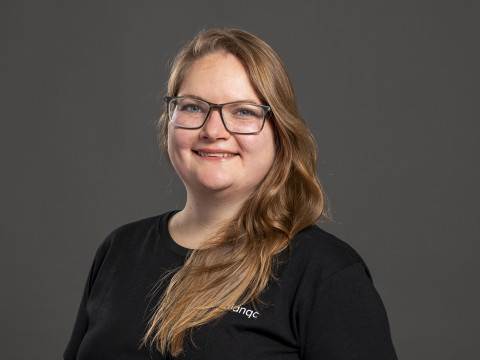
In the second interview of our Women in Quantum blog series, we speak with Monalisa Singh Roy, Quantum Algorithms Engineer at planqc. Working in the Optimization team, she develops quantum and quantum-inspired methods to tackle real-world problems, and shares how curiosity, perseverance, and collaboration have shaped her path into quantum technologies.

Monalisa, what is your name, current role, and your connection to planqc?
Hello, my name is Monalisa (yes, like the painting). I am a quantum algorithms engineer at planqc, where I work in the Optimization team. I develop quantum algorithms and quantum-inspired classical methods to solve real-world optimization (optimisation) problems, especially in finance and logistics.
A central part of my work is to understand where current quantum hardware, which is noisy and has only a limited number of qubits, can already make a meaningful difference, and how to design algorithms that can later take full advantage of fault-tolerant quantum computers.
In parallel, I work with tensor network methods, a family of computational techniques that represent very large and complex systems in a compact way on classical computers. These methods already perform very well on many challenging optimization tasks, so they allow us to test and refine ideas from quantum computing in realistic settings today, while the hardware gradually catches up.
Can you tell us briefly about your professional background and how you joined the company?
I completed my PhD in theoretical physics in Kolkata (formerly Calcutta), India, where I worked on developing advanced numerical methods, such as the density-matrix renormalization group (DMRG), to study strongly correlated quantum systems. These included frustrated quantum magnets and ultracold gases in optical lattices, highly complex and fragile systems that are realized in specialized laboratories around the world.
In my postdoctoral work at Bar-Ilan University in Israel, I shifted my focus to what happens when such systems interact with the real world. I studied how noise, dissipation, and measurements affect and even shape the dynamics of engineered low-dimensional quantum systems, and how these effects can sometimes be turned from a nuisance into a tool.
During this time I visited collaborators at the Max Planck Institute and the Bundeswehr University in Munich. On one of these visits, I attended the Munich Software Forum, where I encountered the Munich Quantum Valley ecosystem of quantum technologies.
It was eye-opening to see quantum algorithms and simulation techniques, very similar to those I had been using to understand quantum matter, being applied to concrete industrial problems. That was a turning point for me. I reached out to planqc, shared my background and motivation, and started speaking with members of the algorithms team. A few months later I joined the company, and I now work on exactly the kind of problems that fascinate me: quantum algorithms for real-world applications.
What inspired you to pursue a career in science, technology, or innovation?
I have always been a curious person, interested in things as varied as art, history, food, literature, and, of course, science. My childhood was spent travelling across India with my parents, changing schools every few years and starting over each time. Recognizing similarities in very different places and learning new skills quickly, whatever the language, culture, or climate, became something I actively enjoyed. I started to look for patterns in everything around me, long before I knew that was exactly what scientists do daily.
Wherever we moved, the first thing we searched for was a library card. These were pre-internet days in India, so the library was my main gateway to the world. I was drawn to stories about how discoveries are made and to the lives behind them. Reading about Marie Curie, Vera Rubin, and Kalpana Chawla showed me that a scientific life could be demanding and yet very human, and that it was possible to genuinely enjoy such work even when it was difficult. The fact that their gender never stopped them from advancing the frontiers of science was an additional beacon.
By the time I finished school in New Delhi, I had realized that the best collection of puzzles, and the thrill of trying to solve them, lay in science and especially in physics. Physics felt unique in allowing one to imagine a world that follows simple rules, guided by intuition, and then to test those ideas with real experiments. Studying theoretical physics in Kolkata, where work on Bose–Einstein statistics, the Saha ionization equation, and the Raman effect was done, was additionally inspiring and made it feel natural to move in that direction.
“The same theoretical ideas that help us understand exotic quantum systems can also be turned into algorithms for real-world problems.”
What still fascinates me today, especially in quantum technologies, is that the same theoretical ideas that help us understand exotic quantum systems can also be turned into algorithms for real-world problems. Quantum hardware is still very young, so many of the important questions are genuinely open and many of the basic tools are still being built. I feel fortunate to work on these questions at such an early stage, and cautiously optimistic that some of the ideas we are exploring now will grow into robust, everyday tools for scientists and engineers in many different fields, helping society to tackle some of its more complex problems.
Being in a field that is still predominantly male, did you experience feeling like a minority during your studies or early career? If so, were there any particular moments, feelings, or challenges, and how did you deal with them?
I grew up in a family where both my parents worked in the same demanding job. My mother was one of very few mathematics graduates and one among only a few women officers amidst thousands of male officers in the 1980s. The fact that women were extremely underrepresented was therefore very visible from childhood, as I heard my mother’s experiences. It made it a natural goal for me to try to push those numbers in a better direction, in whatever field I chose.
During my studies and early career, I have often been one of the very few women in the room. You notice it when you walk into a lecture hall, a group meeting, or a conference session and you automatically count how many women are in the room. At times that came with a feeling of having to perform on behalf of a whole group that was not yet present, which is an extra layer of pressure nobody asks for.
There were moments of self-doubt, of wondering whether I was meant to be in that room. Those thoughts usually dissolved when I remembered the giants on whose shoulders we stand, from Marie Curie, Vera Rubin, and Jane Goodall to many other stalwarts, and also my lecturers at Bethune College, who never allowed their gender to slow them down.
What helped me most was that in the best groups I have worked in, researchers usually were “just physicists”. Once everyone is occupied with a calculation, an experiment, or a deadline, what matters is whether you are engaged with the problem and willing to help each other. In those environments I felt seen for my work first, and everything else second.
At the same time, I have learned how important it is to have spaces where you do not have to explain any of this and be questioned instead. The MCQST women’s lunch meetings in Munich were a great space for me. Women at different career stages sitting together, sharing their own honest experiences, and giving each other practical advice has felt extremely supportive and helpful. I appreciate that planqc also supports this kind of exchange internally through its Buddy program, for it indeed makes a difference.
Of course, the field of quantum technology, like many other STEM fields, would benefit from far more diversity than is presently visible. But compared to when I started, I see more women in the room, more awareness, louder voices, and more people trying to make things better. This, together with the support I have received from colleagues and mentors, makes me genuinely optimistic.
“There were moments of self-doubt, of wondering whether I was meant to be in that room.”
What has been a highlight or proudest moment in your career so far?
I have had the good fortune to work with many excellent research groups across the world. One moment that stands out very clearly is from my PhD. For about half a year I had been working on a fully fermionic DMRG algorithm to study topological properties of trapped, spin–orbit coupled ultracold atomic gases. There were many ups and downs, and for months the results simply refused to behave.
I still remember the evening when the algorithm finally ran to completion, and the data matched our physical intuition and benchmarks. It was a regular day in the office, but the adrenaline rush felt unlike anything I had experienced. For the first time, I felt that I had built a state-of-the-art tool at the quantum research frontier, accurate enough to answer the complex questions we were asking.
Since then, my PhD group has used and extended that algorithm for many other applications, including the search for elusive superconducting phases in cold atomic gases. Knowing that this work has had a life beyond my own project and is still helping to uncover new states of matter is very rewarding. The long stretch of uncertainty followed by that moment when everything finally came together remains one of the most exhilarating experiences of my career so far.
What is your role within the company, and how does your work contribute to planqc’s mission?
At planqc, I develop and benchmark algorithms for hard optimization tasks in areas such as finance and logistics. I focus on two complementary directions.
On one side, I help design digital quantum circuits that can be implemented on planqc’s neutral-atom hardware, tailored to its strengths, and I study where “quantum” might already offer a meaningful advantage. On the other side, I build quantum-inspired tensor network solvers that run on classical computers, using ideas from many-body physics.
Day to day, this means translating real-world questions into mathematical structures that both our quantum processors and our classical simulators can work with, and collaborating closely with colleagues across different specializations to close the loop between theory, hardware, and applications. The hardware and the algorithms are both still evolving, which makes this a particularly exciting time to work in the field.
Why do you think diversity of roles – from research to administration, business development, HR, and beyond – is important in quantum technology?
Building a useful quantum computer is not only a research problem but also an engineering, organizational, and societal challenge. For this to happen, we need many different kinds of expertise in the same room.
From my perspective inside the algorithms team, our work only makes sense as part of a larger whole: experimentalists, control engineers, software engineers, colleagues in business development, product, partnerships, administration, HR, and operations. When these roles work together, the outcome is more than the sum of its parts.
Diversity of roles also brings diversity of ways of thinking, which is especially valuable in a young field like quantum technology.
“Diversity of roles also brings diversity of ways of thinking, which is especially valuable in a young field like quantum technology.”
What do you enjoy most about working at planqc?
What I enjoy most at planqc is how spontaneous teamwork, innovation, and company culture go hand in hand. It feels normal to walk up to anyone and start a serious discussion about a hard problem or a speculative idea. Some of my favorite places in the office are the kitchen, the coffee counter, and the lunch tables. Many great ideas start there.
I also appreciate the basic trust and openness in the way people work together. That combination of intellectual freedom, collaboration, and kindness is what makes planqc a place I look forward to coming to.
What is your vision for the future of women in science, technology, or quantum?
My hope is a world where women and other underrepresented groups are present at every level of science and technology and are not seen as exceptions. For quantum technologies in particular, we are not only building hardware and algorithms but also setting the norms of the field. I hope people are judged mainly on the clarity of their ideas, their curiosity, and how they treat their colleagues.
I am realistic that change takes time, but I am rather optimistic that we are moving in the right direction.
What advice would you give to young women considering a career in science, technology, or innovation?
Give yourself permission to be genuinely curious and take that curiosity seriously. Follow what captures your attention. Stay close to who you really are. Develop your own strengths rather than trying to imitate an imaginary standard. Look for good mentors and good peers. Doubt and failure are part of the process. They do not disqualify you. Science and innovation are team efforts. Ask questions. Offer help. Take breaks. Keep going step by step.
What is your favorite quote or motto?
“The best is yet to come, let’s bring it forward now!” by Monalisa Singh Roy.
Is there a fun fact about you that you’d like to share?
I started learning the violin for a very unromantic reason: I was struggling to understand the acoustic modes of vibrating strings in a physics course. By the time the exams came around I not only understood the acoustics better, I had also fallen in love with the violin and with music beyond its mathematical description.
Another slightly odd fact is that I am very bad at remembering faces but rather good at remembering conversations, even from many years ago. I often invent small “toy models” for everyday problems. Write to me at monalisa.roy@planqc.eu if you might like some entanglement jokes, too!
More Women in Quantum
-

Meet Valentina Tammaro, Head of People & Culture at planqc
-
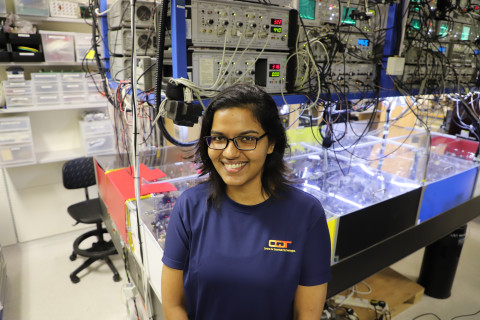
Meet Athira Krishnan Sreedevi, Quantum Hardware Engineer at planqc
-
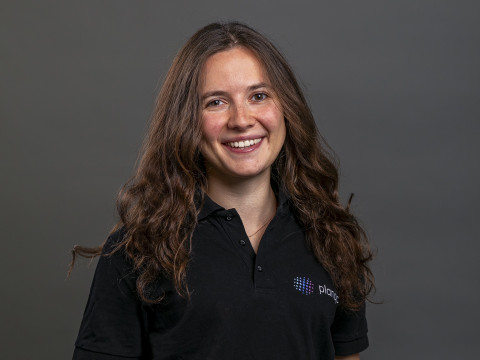
Meet Ayse Kotil, Team Lead for Gate-Based Quantum Optimization at planqc
-
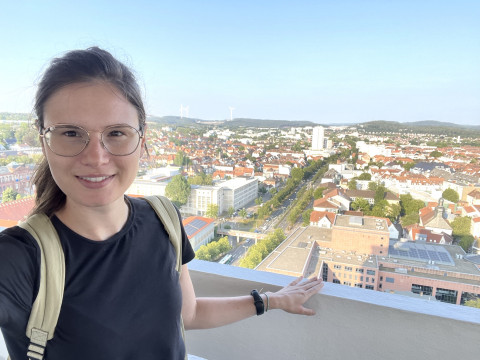
Meet Alice Bellettini, Quantum Algorithms Engineer at planqc
-
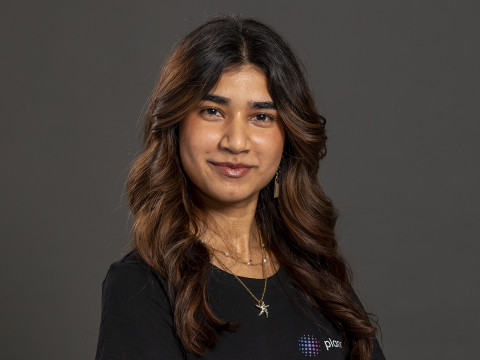
Meet Ria Jobanputra, Quantum Algorithms Engineer at planqc
-
Meet Jennifer Lilieholm, Quantum Hardware Engineer at planqc